7 Best Conference Networking Apps for 2026 & How To Choose
June 10, 2026 · Wout Criekemans · 12 minute read
Table of Contents
- 1. LineUpr: Best for organizers who need networking attendees actually adopt
- 2. Whova: Best for mid-to-large conferences
- 3. Swapcard: Best for trade shows where exhibitor lead capture is the point
- 4. Brella: Best for large B2B conferences built around matchmaking
- 5. Eventee: Best for organizers who prioritize a clean, intuitive interface
- 6. Eventify: Best for B2B-heavy programs that run on tag-based matching
- 7. Amego: Best for modern 1:1 matchmaking and digital badge exchange
- How to choose the right conference networking app
- Turn a full room into real connections
- Frequently asked questions
You booked the right speakers. The room was full. And people still walked out without making the three connections that would've made the event worth it. Business cards in a drawer, a LinkedIn request that never got sent. A "we should talk" that never happened.
Most conference networking apps promise to fix this with smarter matchmaking: AI that pairs attendees by interest, meeting schedulers, recommendation engines. All useful. All beside the point if the app never gets opened. An algorithm can't introduce two people who never joined, and the most common reason they don't join is because they couldn’t get past the download/sign-in screen.
So before comparing matchmaking features, the question that actually decides whether networking happens at your event is narrower: will the people in the room actually use this? A networking app that 40% of attendees install is a worse networking tool than a simpler one that 80% open, regardless of which has the better algorithm.
A few things separate the apps that get used from the ones that get ignored:
Attendees can get in without a barrier. A link or a QR code beats an app-store download every time. This is the single biggest predictor of whether networking happens at all.
The networking is sized to your event. A tool built for a 5,000-person trade show with exhibitor lead capture will overwhelm a 200-person conference. And the unused complexity is what discounts adoption.
It's live and editable the moment plans change. A speaker drops, a room moves, a late batch of attendees registers. The tool has to keep up in real time.
Below are seven of the strongest conference networking apps for 2026, starting with LineUpr, the only option built around adoption first and other options best for specific kinds of events we'll name as we go.
Build your event app free. No download for attendees. Nothing to install.
1. LineUpr: Best for organizers who need networking attendees actually adopt
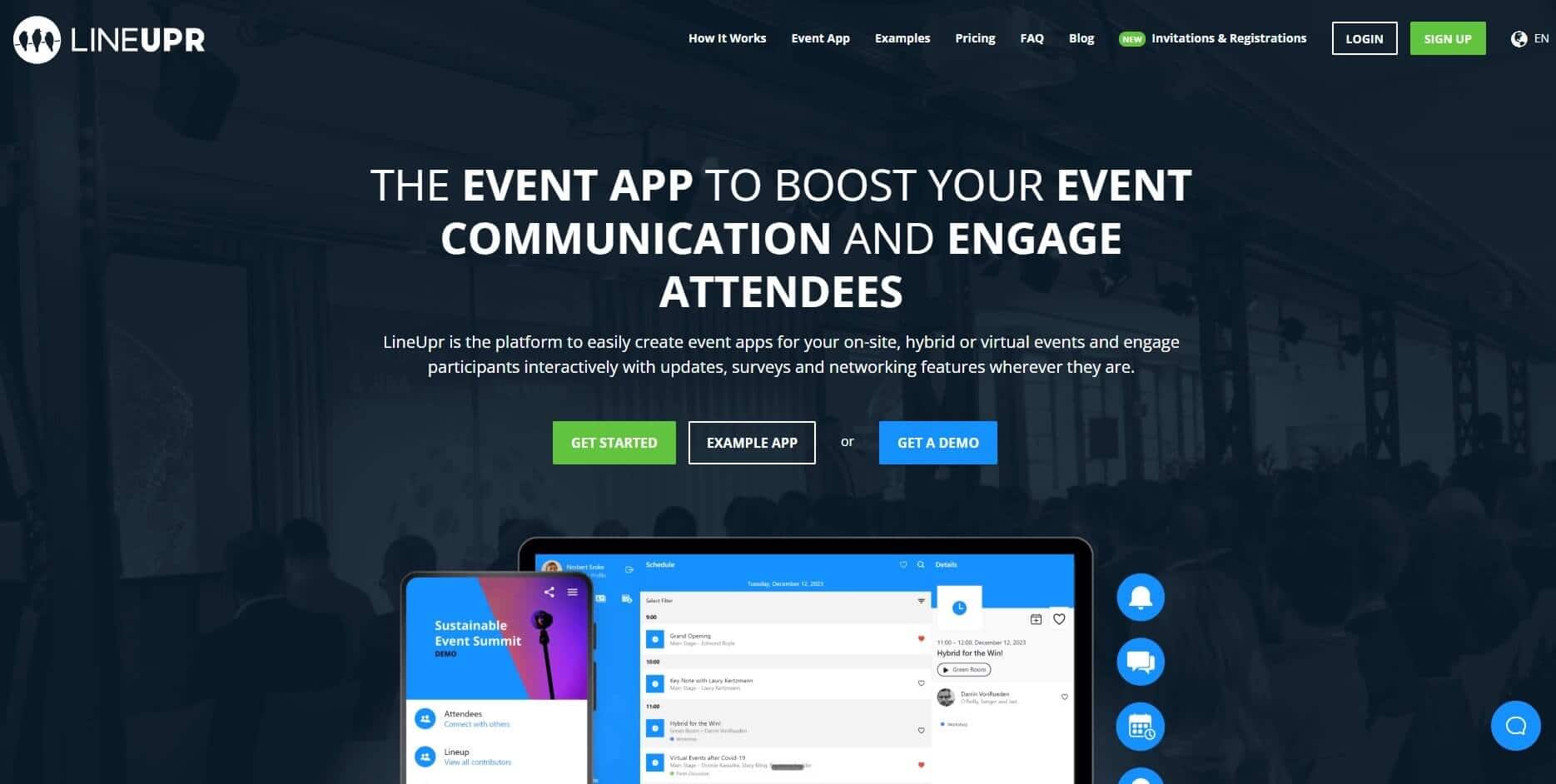
LineUpr is a browser-based event app that makes it easy for event organizers to help attendees connect with the people worth meeting, without paying for an enterprise event platform or hiring a developer to build a custom app.
Instead of leaving attendee networking to chance run-ins at the coffee break and a stack of business cards, LineUpr gives attendees real ways to find and reach each other:
Attendee profiles: attendees can see who's in the room and spot who's worth meeting before the first session — so they walk in already knowing who they want to find.
Public and private chat: attendees break the ice and keep conversations going in real time, without waiting for a perfectly timed hallway moment.
Digital business card exchange: contacts are saved with a tap and stay accessible long after the closing session, instead of getting lost or forgotten.
One-to-one video calls: attendees turn a quick intro into a real conversation — including with remote attendees, or as a follow-up once the event is over.
Unlike other tools, it doesn't require a download.
Attendees tap a link or scan a QR code and they're straight into the attendee list, profiles, and agenda — no app store, no account, no install. That way, it lifts attendee adoption by removing the step where most networking apps lose half their audience before networking has even started. At one workshop event, organizers used LineUpr to increase event attendee usage by 70%.
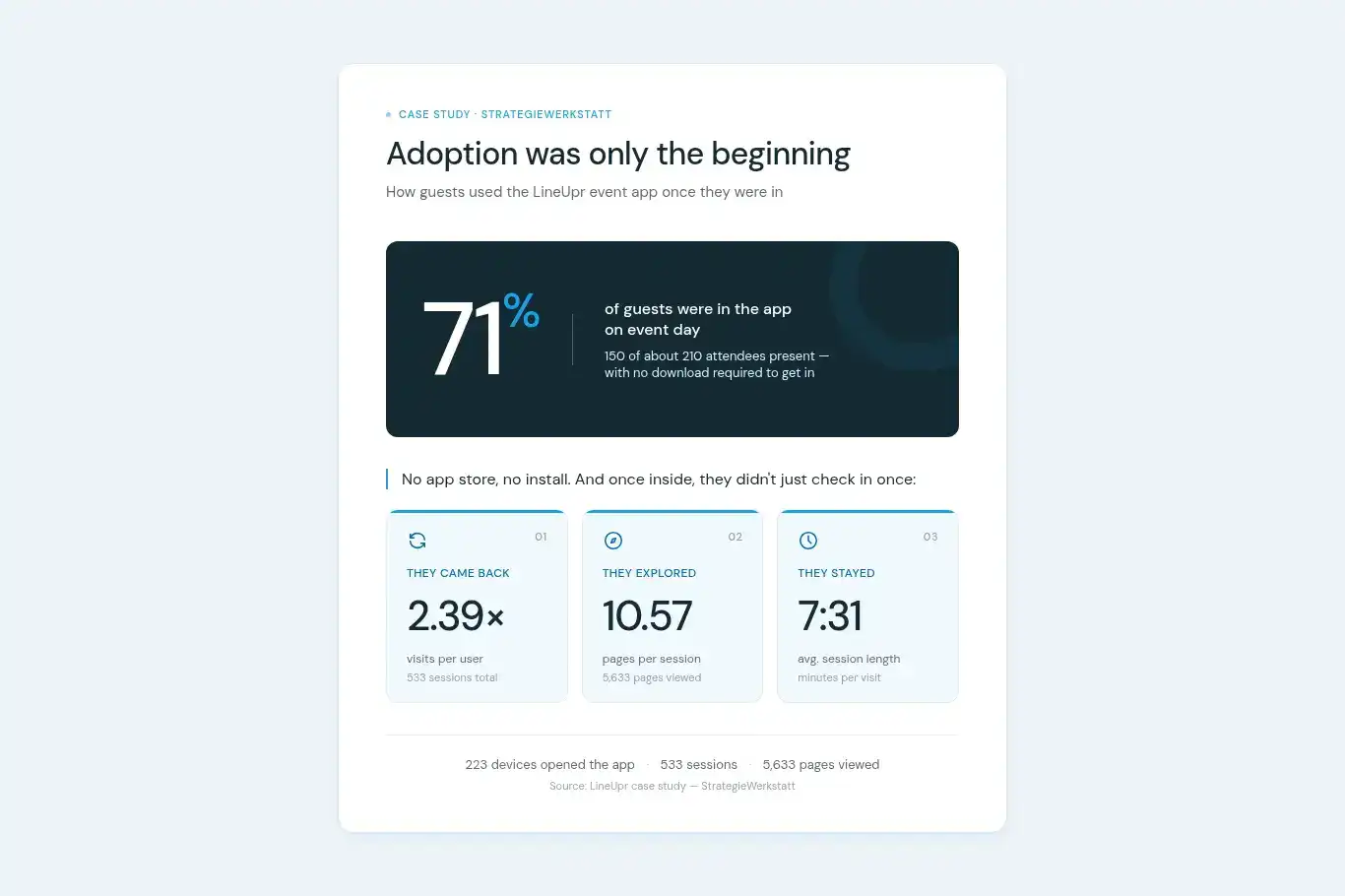
Best used for: Conferences, association meetings, and corporate events where the goal is getting attendees to actually connect, not running a sponsor marketplace.
Pricing: LineUpr runs on a transparent per-event pricing model — you can build and preview a complete app for free, and you only pay when you're ready to go live, with no quote request or sales call required to see what it costs.
If that's what your event team needs, try LineUpr today. Build your event app in 30 minutes and see how LineUpr turns a full room into real connections
2. Whova: Best for mid-to-large conferences
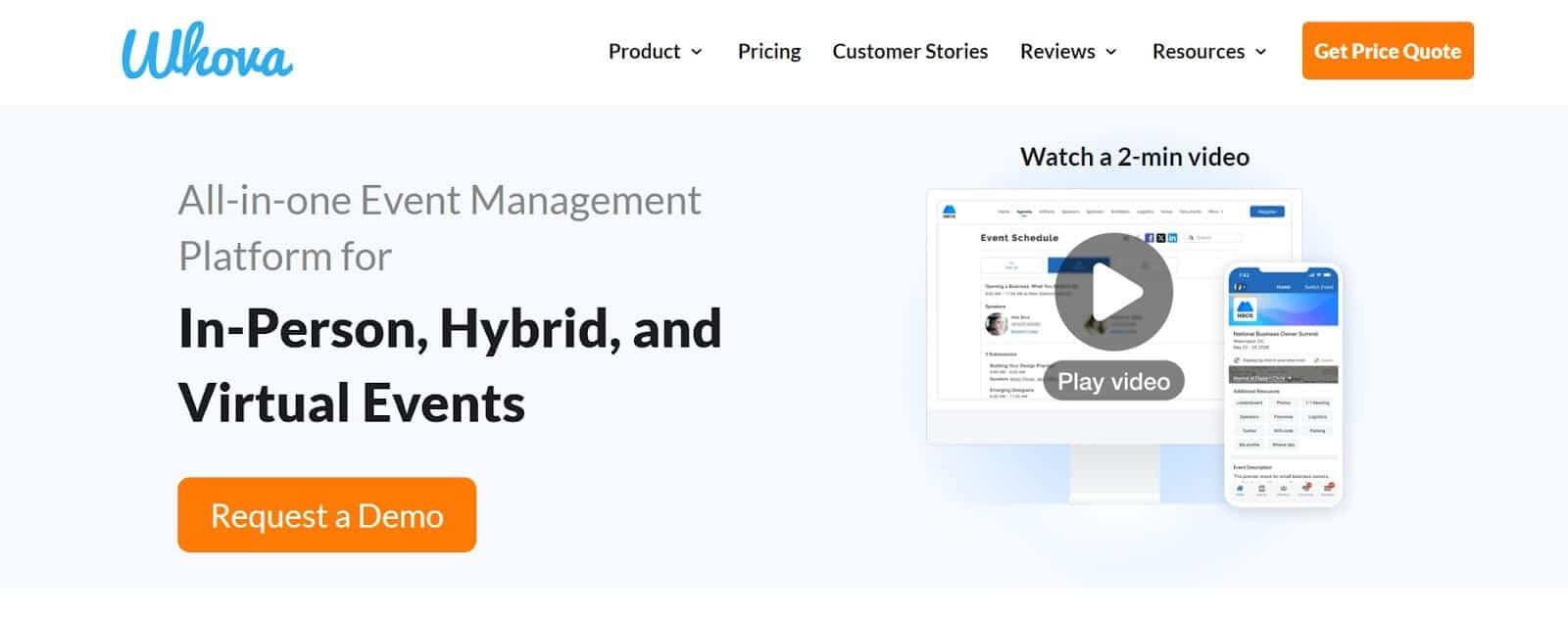
Whova is the most widely recognized conference app on this list, and for good reason — it's proven at scale across large conferences, associations, and trade shows. Its standout is the community board: attendees post meetups, ask questions, and start discussions sometimes days before the event opens, which generates real engagement ahead of time. Its networking toolkit is deep, including attendee profiles, business-card scanning, in-app messaging, meeting scheduling, and speed networking.
Community board for pre-event meetups and discussion
AI attendee matchmaking and profiles
Business-card scanning and contact exchange
Meeting scheduler and in-app messaging
Native iOS/Android app
The trade-offs are scale-related. Whova is a native download, so it inherits the install barrier — and reviewers consistently note limited branding customization and that it can feel feature-heavy for smaller events.
Pricing is quote-based: you submit a request and talk to sales before you see a number. For a large conference where networking depth is the priority and an attendee base motivated enough to download, Whova is a strong default.
3. Swapcard: Best for trade shows where exhibitor lead capture is the point
Swapcard is built for hybrid and B2B events with a heavy exhibitor and sponsor component. Its strength is the structured side of networking: AI-driven 1:1 meeting scheduling, interactive exhibitor spaces, and QR-code badge scanning for lead capture. If your event's commercial model runs on connecting attendees with exhibitors and proving ROI to sponsors, this is squarely its territory.
AI matchmaking and 1:1 meeting scheduling
Interactive exhibitor and sponsor booths
QR badge scanning and lead retrieval
Hybrid and virtual event support
That focus is also the limit. Swapcard is built around the exhibitor-driven trade-show model, which means setup and complexity scale accordingly — and it expects a sales conversation rather than transparent self-serve pricing. For a conference without an exhibitor floor, much of what you'd pay for would go unused.
4. Brella: Best for large B2B conferences built around matchmaking
Brella's entire identity is matchmaking. Its AI pairs attendees based on specific goals and interests they set up front, and it's well-regarded for large B2B conferences where the primary reason people attend is to meet the right counterparts. If networking is the product of your event and you have the scale to feed the algorithm, Brella does this one thing very well.
Goal- and interest-based AI matchmaking
1:1 meeting scheduling
Strong fit for large-scale B2B programs
The flip side: a matchmaking-first platform built for scale is more than a mid-sized conference needs, and it carries the adoption tax of a heavier tool with a sales-led buying process. The quality of matches also depends on a large, engaged attendee base actively filling out their goals — which loops back to the adoption question.
5. Eventee: Best for organizers who prioritize a clean, intuitive interface
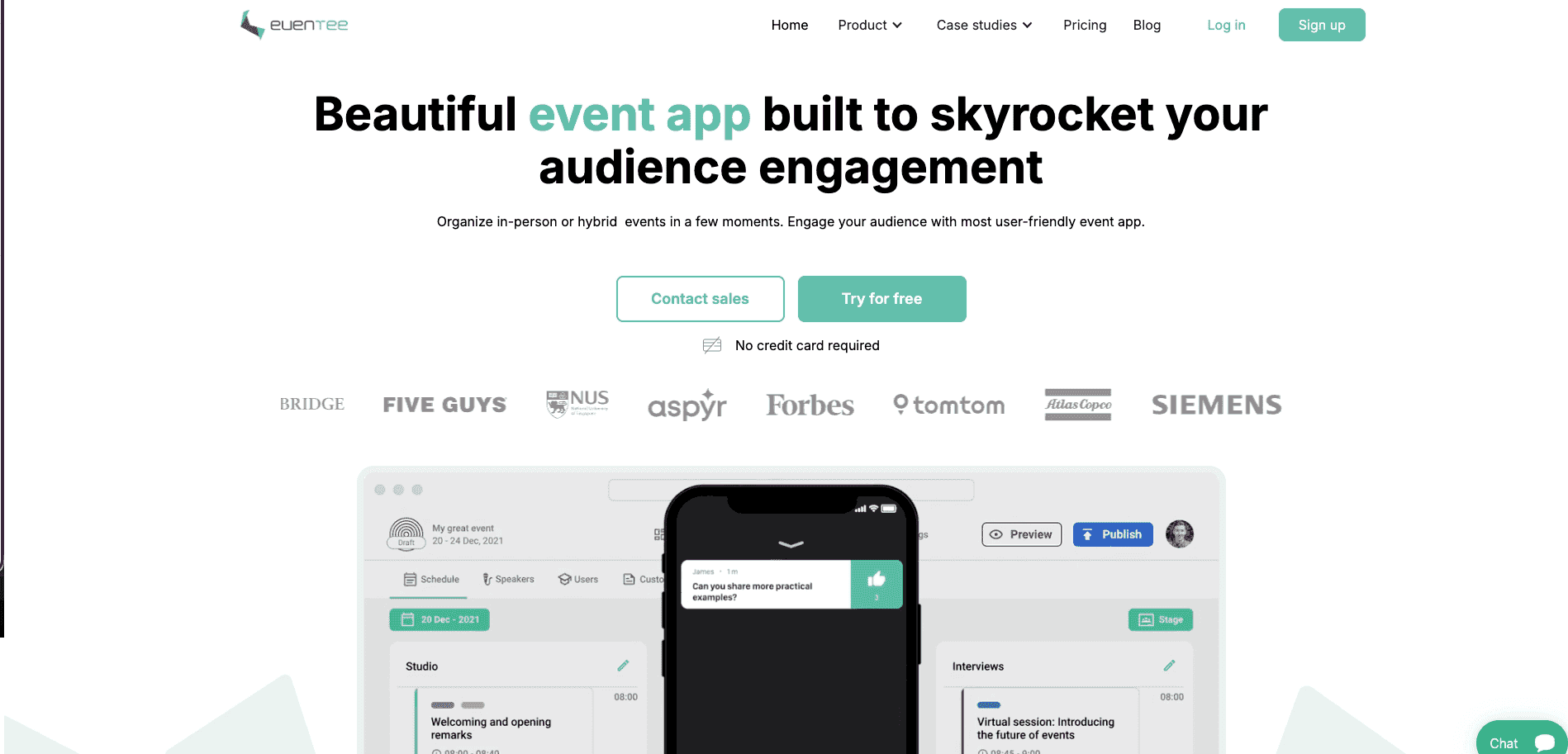
Eventee earns genuine praise for its interface — it's one of the easier event apps to set up and one of the more pleasant for attendees to use, with a swipe-through profile model for discovering connections, a social wall, and live Q&A. On user experience, it's a real competitor, and worth a serious look if design and simplicity are your top criteria.
Swipe-to-connect attendee profiles
Social wall and live Q&A
Fast setup, well-rated for ease of use
Free until you're ready to launch
The distinction that matters for this list: Eventee is a native app attendees download. So while the in-app experience is polished, it still asks attendees to clear the install hurdle first — the same step that suppresses adoption regardless of how good the interface is once you're past it. If your audience reliably downloads event apps, the experience is excellent; if adoption is your worry, that's the variable to weigh.
6. Eventify: Best for B2B-heavy programs that run on tag-based matching
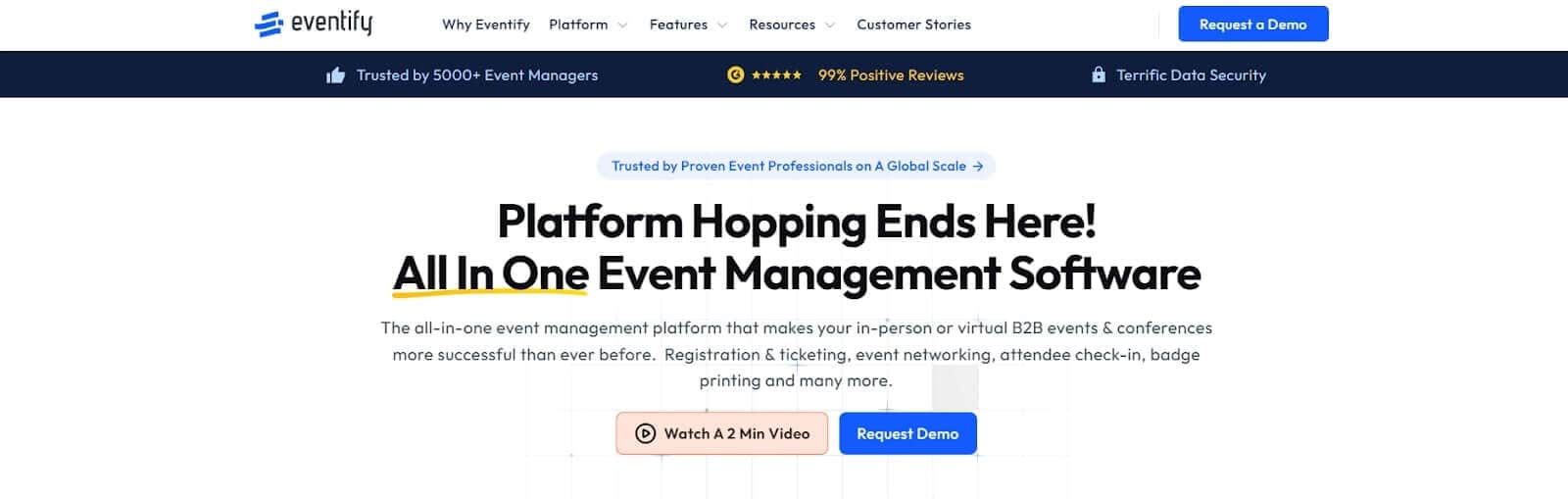
Eventify's networking centers on tag-based matchmaking: attendees add up to 20 interest tags at registration, and the app pairs people by similarity score. It rounds this out with 1:1 meeting scheduling, private messaging, a community builder, and push notifications, and positions itself strongly for B2B and virtual networking.
Tag-based matchmaking (up to 20 interest tags)
1:1 meetings and private messaging
Community builder and social timeline
B2B and virtual networking focus
Pricing is contact-us, with a credit-based model charged per attendee — workable, but it means you'll need a conversation and a headcount estimate before you know your cost, and the per-attendee structure is something to model carefully for larger events. The tag-matching approach works best when attendees actually complete their tags, which again rewards tools that get high participation in the first place.
7. Amego: Best for modern 1:1 matchmaking and digital badge exchange
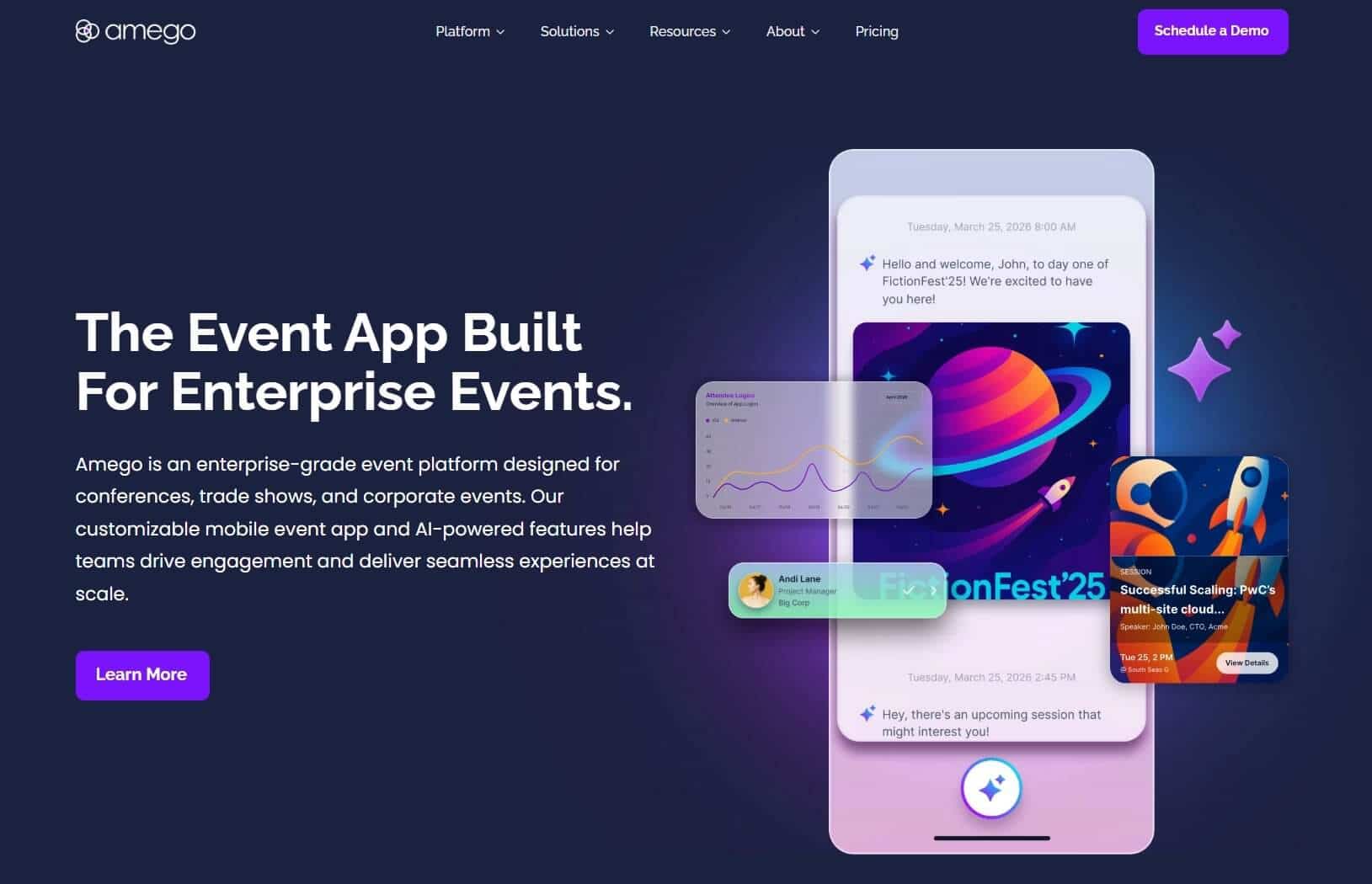
Amego is a newer, modern entrant that does networking well: AI recommends relevant matches based on shared interests, roles, or goals; attendees schedule 1:1 meetings in-app; and digital badges let people exchange contact info by scanning a QR code that links to a profile. It also leans into gamification to nudge hesitant attendees into making connections.
AI 1:1 matchmaking by interest, role, and goal
Digital badges with QR contact exchange
In-app chat with visibility controls
Gamification to encourage networking
Amego is a capable, well-designed option, particularly for organizers who want a contemporary feel and strong attendee-side networking. As a platform aimed at the broader conference market, it's worth evaluating against your event size and how its access model fits your audience's willingness to adopt a new tool.
How to choose the right conference networking app
The best conference networking app is the one that fits how your event actually runs — and, above all, the one your attendees will actually open. A quick way to sort yourself:
If networking is the entire reason your event exists — a large B2B conference or matchmaking-driven summit with a motivated, download-willing audience — a matchmaking-first platform like Brella or Whova earns its depth.
If you're running a trade show with exhibitors and sponsors who need lead capture and ROI reporting, Swapcard is built for exactly that.
If interface polish is your top priority and your audience reliably installs apps, Eventee is hard to beat on experience.
If your real challenge is getting attendees to show up and connect at all — a conference, association meeting, or corporate event where adoption, not algorithmic depth, is the bottleneck — LineUpr removes the download barrier that quietly kills most networking before it starts.
Match the tool to the event, but weigh adoption first. Deep features applied to a third of the room lose to good-enough features the whole room uses.
Turn a full room into real connections
If your event lives or dies on whether attendees connect, the deciding factor isn't which app has the cleverest matchmaking — it's which one the room actually opens. For conferences, association meetings, and corporate events, that's where a no-download, browser-based app wins: it puts most of your attendees inside the tool from the first scan, and gives networking a base large enough to compound.
LineUpr is built for exactly that reader — the organizer who needs participation, not a feature arms race:
Attendees join by link or QR code, with nothing to download
Profiles, messaging, contact exchange, and 1:1 video calls for real connection
Live, editable agenda and instant push updates when plans change
Build and preview the whole app for free, with transparent per-event pricing
Ready to see how LineUpr turns a full room into real connections — without asking a single attendee to download anything?
Frequently asked questions
What's the best app for conference networking? It depends on event size. For large B2B conferences built around matchmaking, Whova and Brella lead. For trade shows with exhibitors, Swapcard fits. For conferences and association events where getting attendees to actually use the app is the priority, LineUpr's no-download approach drives the highest participation.
Do attendees have to download a conference networking app? Not always. Native apps (Whova, Eventee) require an app-store download and account. Browser-based apps like LineUpr open from a link or QR code with nothing to install — which is the main reason web-based apps tend to see higher attendee adoption.
Are there free conference networking apps? Several offer free tiers or free trials. LineUpr lets you build and preview a complete event app for free and only pay when you go live; Eventee is free until you launch. Most matchmaking-heavy platforms (Whova, Swapcard, Eventify) are quote- or contact-based.
What makes attendees actually use a networking app? Removing friction. The fewer steps between an attendee and being inside the app — no download, no account, no permissions — the more of them participate. Adoption is the single biggest predictor of whether networking actually happens at your event.